Where the skyscraper was born
Chicago did not invent tall buildings, but it worked out how to hang them on a metal frame, and you can still walk the evidence in an afternoon. This guide follows the story from the ashes of 1871 to the glass towers of Mies and the Willis Tower, one building at a time, with the walks that tell each chapter.
Why the tall office building started here
The Great Chicago Fire of 1871 burned much of the city center, and the rebuilding pulled a generation of ambitious architects into a downtown that had to start over. Land in the small business district, boxed in by the river and the lake, grew expensive fast, so the obvious way to earn more from a lot was to stack more floors on it. Two things made that possible. Passenger elevators had become safe enough to trust. Iron and then steel were getting cheap enough to carry a building on a frame instead of on thick walls. Add insurance companies and banks hungry for prestige, and the Loop turned into a testing ground.
The architects who answered are now grouped as the Chicago School. The names to know are William Le Baron Jenney, the partners Burnham & Root, the firm of Holabird & Roche and Louis Sullivan, who summed up the approach as "form follows function". Their towers look sober next to the Art Deco that came later (see Chicago's Art Deco buildings), but they were after daylight and open floors more than borrowed historical dress, even when Sullivan wrapped his in ornament of his own.
The Home Insurance Building and the frame
The building most often called the first skyscraper was the Home Insurance Building, finished in 1885 at LaSalle and Adams to a design by Jenney. It stood about ten stories, modest by later standards, but a metal frame inside carried much of the weight that walls had carried before. Historians still argue over the title, since earlier buildings used iron too and its outer walls still did some of the work. It was demolished in 1931, and the Field Building took its place, so the spot where the story starts now holds a much later chapter.
The Rookery and the Monadnock, two ways up
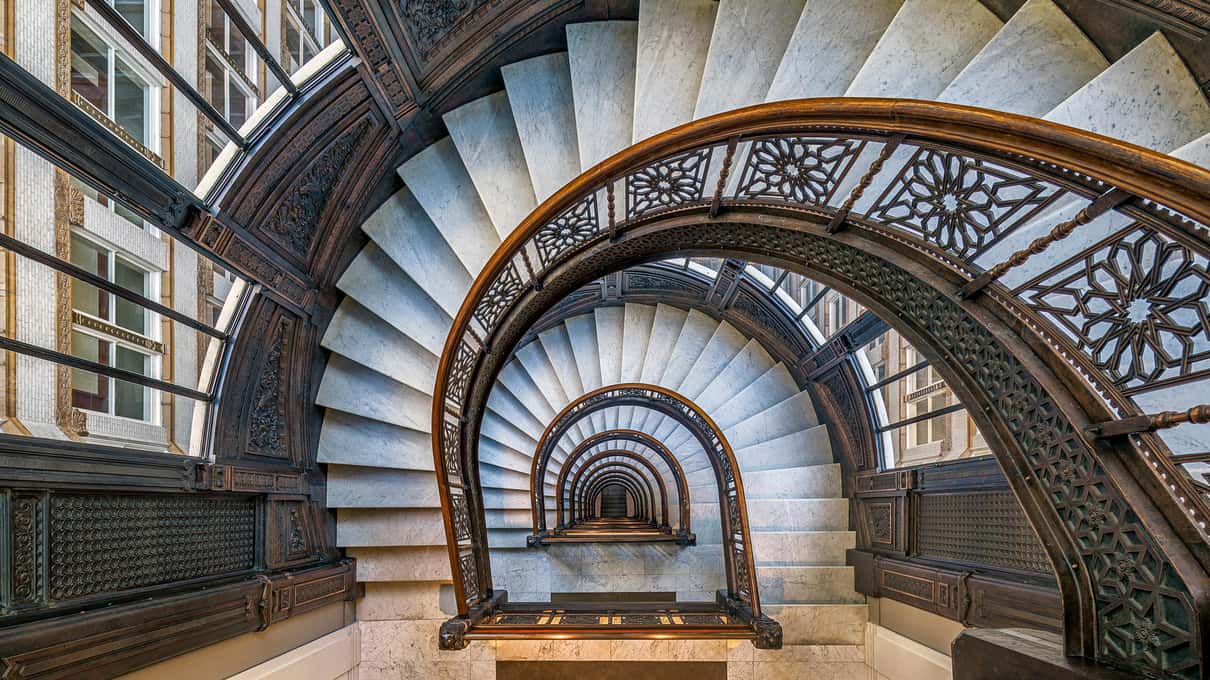
The Rookery at 209 S. LaSalle Street (1888, Burnham & Root) sits halfway between the old method and the new. Its heavy outer walls are masonry, while the inside rests on iron columns and beams arranged around a glass-roofed light court that brought daylight to the offices. Frank Lloyd Wright remodeled that court in 1905, and our guide to Wright in the Loop and Oak Park tells that part. The building also hides a spiral staircase curling up through a projecting bay, the oriel stair in the photo below. The lobby is a working space and closes on Sundays.
The Monadnock Building on Dearborn Street shows both methods in one long block. The north half, finished in 1891 to Burnham & Root's design, stands on load-bearing brick walls about 6 feet (1.8 m) thick at the base, which is why the ground-floor windows sit in such deep openings. It rises 16 stories with almost no ornament. The south half of 1893, by Holabird & Roche, uses a steel frame instead. Walk the full length and you pass the moment the old way of building ran out of room.
Glass and terra cotta on State Street
Once a frame carried the load, walls could become mostly glass. The Reliance Building (1895) at State and Washington looks startlingly modern for its age, a slim tower of big windows set in white terra cotta. It is now a hotel. Nearby on Dearborn, the Marquette Building (1895, Holabird & Roche) shows off the Chicago window, a wide fixed pane flanked by two narrow ones that open, and has a mosaic lobby, open like every lobby here only when the building allows. Louis Sullivan's department store, now the Sullivan Center, wraps its rounded corner on State Street in cast-iron ornament, a reminder that form following function never meant bare.
The Golden Age with a CAC docent
The Chicago Architecture Center's two-hour Historic Treasures walk usually takes in the Reliance Building on State Street and the decades from the 1890s to the 1930s, from ~$35, with entry to the CAC's exhibits in the ticket. It goes ahead rain or shine, and both sites refund in full up to 24 hours before.
Mies and the glass box
After the Second World War the story picked up again with Ludwig Mies van der Rohe, who had moved to Chicago before the war. His twin apartment towers at 860–880 Lake Shore Drive (1951) are steel and glass with nothing added, and the Federal Center in the Loop applies the same discipline to government offices around a plaza where Alexander Calder's red Flamingo (1974) gives the black steel something to argue with.
The CAC's Modern Architecture walk, from ~$35, picks up right here with the Mies years and Bertrand Goldberg's towers before moving on to postmodernism. Its catch is length and reach, since it lasts only 90 minutes and sells on Viator only, so you cannot compare it on GetYourGuide. It starts at the CAC, where the big scale model of the city makes a good orientation.
From bundled tubes to wavy balconies
The engineers at SOM pushed the frame further still. The John Hancock Center (1969) on North Michigan Avenue braces itself with giant X shapes you can read from blocks away, and the Willis Tower (1973, still the Sears Tower to many locals) bundles nine square tubes of different heights into one. At 1,451 feet (442 m) it was the tallest building in the world for roughly a quarter century. By the river, Bertrand Goldberg's twin Marina City towers of the 1960s, nicknamed the corn cobs, stack round apartments above spiral parking floors, and Jeanne Gang's Aqua (2009) ripples with wavy concrete balconies.
The CAC's Must-See Chicago walk, from ~$35, covers the newer end in 90 minutes. It usually passes Aqua and the Tribune Tower (1925), whose Gothic crown came out of a 1922 design competition. For more towers in less time, Wendella's river architecture cruise, from ~$45, shows dozens in an hour and a half while you sit. Its catch is the angle. You see the skyscrapers from below the bridges and never set foot in a lobby, and in summer the big boats get busy.
Which walk tells which chapter
For the 1880s, the Rookery is the stop that matters, and two walks usually go inside. Inside Chicago's Dazzling Interiors walk, from ~$35, keeps it among its surprise stops (the listing describes an 1880s building renovated by Wright), while Empire Tours' Secret Interiors walk, from ~$30, sets off from Union Station and works up the LaSalle Street canyon before stepping into the light court. On Sundays Empire swaps the Rookery for another stop, and on any day a lobby can shut for an event or for security, so neither walk can promise every door.
For the 1890s, the CAC's Historic Treasures walk is the one that reaches the Reliance. Anyone after the modern towers should pick the Must-See walk or the Modern walk. If you would rather go alone, our self-guided Loop walk strings most of these buildings into a free route of about 2 miles (3 km). The Loop interiors you can walk into lists the lobbies you can try on your own. Our river cruise or walking tour comparison sets the boat against the sidewalk.