A self-guided Loop architecture walk
You can see a great deal of the Loop for the price of comfortable shoes. This route runs about 2 miles (3 km) from Union Station to the Tribune Tower, past the buildings that taught the world how to build tall and through lobbies that are free to enter when open. At the end, we are frank about what a paid guide adds that a map cannot.
The route at a glance
This walk crosses the Loop from west to east and then turns north to the river, about 2 miles (3 km) of walking before any detours. With time inside the lobbies, plan on roughly three hours, but treat every time here as a guess, since one long look at a Tiffany ceiling can swallow twenty minutes. It costs nothing unless you stop for coffee.
- Union Station's Great Hall
- The Willis Tower, seen from Wacker Drive
- The Rookery and the Board of Trade on LaSalle Street
- The Monadnock and the Federal Center plaza on Dearborn Street
- The Marquette Building's lobby
- The Sullivan Center and the Reliance Building on State Street
- The Tiffany ceiling at Macy's
- The Picasso in Daley Plaza
- The Chicago Cultural Center
- Millennium Park
- The Wrigley Building and the Tribune Tower by the river
Union Station to LaSalle Street
Start inside Union Station, just west of the river, where the Great Hall rises under a skylight and Empire Tours gathers its walkers. Cross the river eastward and look up from Wacker Drive at the Willis Tower, finished in 1973 by SOM as the Sears Tower. From the sidewalk you can see how its black tubes step back as they climb.
Walk on to LaSalle Street. The Rookery of 1888 looks heavy and dark outside, yet its light court feels airy and white, thanks to a remodel by Frank Lloyd Wright in 1905. It is closed on Sundays, and other days are not guaranteed either. A few steps south, the Art Deco Board of Trade of 1930 closes the end of the street, with Ceres, the goddess of grain, on top. The narrow canyon in front of it has appeared in more than one Batman film.
Dearborn Street, brick against steel
One block east, two approaches to a tall building face each other. The Monadnock is really two buildings, the older north end held up by massive brick walls and the newer south end by a steel frame. Across Dearborn, the Federal Center by Mies van der Rohe gives you black steel and glass around an open plaza, and Calder's red Flamingo of 1974 stands in the middle of it. Walk north to the Marquette Building and step into its lobby if the door is open, for mosaics that tell the story of the French explorer the building is named for.
If the Mies corner catches your eye, the CAC's Modern architecture walk, from ~$35, picks up that thread with a docent, from Mies to Bertrand Goldberg. The catch is a short 90 minutes, and you can only book it on Viator.
State Street ornament
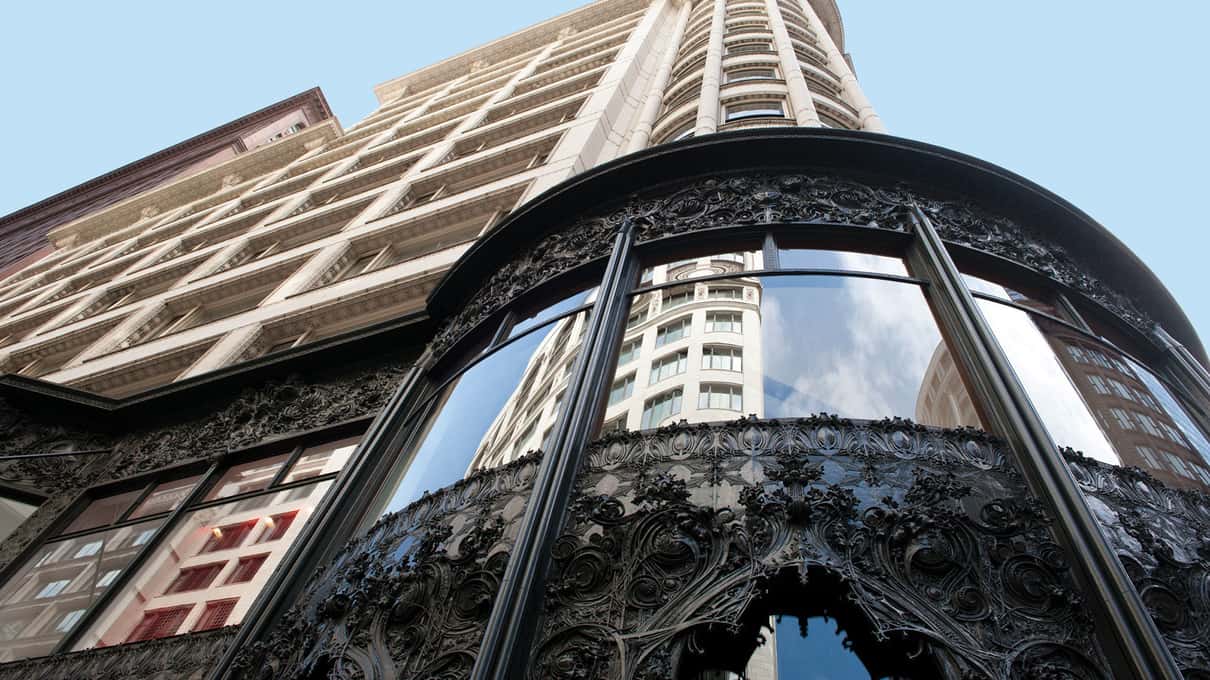
Reach State Street at Madison, where the Sullivan Center wraps its rounded corner in cast-iron ornament by Louis Sullivan. Stand across the street to see the whole entrance, then cross over to study the leaves and tendrils up close. A block north, the Reliance Building of 1895 is almost all glass and white terra cotta, and it now works as a hotel. Across Washington Street, Macy's occupies the old Marshall Field's store, where a Tiffany mosaic ceiling covers part of the building. It is a store first, so admire the dome without blocking the aisles.
When the sidewalks are frozen
Inside Chicago's Pedway walk keeps 15 people at most in the tunnels and concourses under the Loop for two hours, with stops at the Picasso and Macy's, from ~$35. Expect a few staircases, and cancel free up to 24 hours ahead.
Daley Plaza to the lake
Head west along Washington Street to Daley Plaza, where the Picasso of 1967 has kept people arguing for decades over what it depicts. Then turn back east toward the lake. The Chicago Cultural Center, the public library of 1897, is free to enter when open, and its upstairs hall holds the Tiffany dome that most guided walks save for the end. It has restrooms too, which matters at this point of the walk. Cross Michigan Avenue into Millennium Park for the Bean and a bench.
North along the river
Follow Michigan Avenue north to the Chicago River. On the far bank, the Wrigley Building of the 1920s glows in white terra cotta, and across the street the Gothic Tribune Tower of 1925 came out of a design competition held a few years earlier. Look for the stones from famous buildings set into its base. Close by, the Chicago Architecture Center at 111 E Wacker Drive charges for its exhibits, which are included on the CAC's walks.
If your legs are done, the river does the rest. Wendella's 90-minute river architecture cruise, from ~$45, docks near the Wrigley Building and offers indoor or deck seats. The catch is the size of the boats, which fill up in summer, and a cruise shows facades only. River cruise or walking tour compares the two.
Timing and weather
- Go on a weekday. Office lobbies are more likely to be open, and the Rookery closes on Sundays;
- Use the Pedway in bad weather. Its tunnels link dozens of downtown buildings, so you can skip a block of sleet; the best time for an architecture walk covers the seasons;
- Start at the CAC if you like context. Its scale model of about 4,000 buildings shows the whole route before you walk it, though entry costs money unless you are on a CAC walk;
- Carry water and layers. Wind off the lake can make the riverbank feel colder than the streets of the Loop.
What you miss without a guide
A map gets you to the front doors. It does not tell you why the Monadnock's walls had to be that thick, or which of the stained-glass passages under the Loop connect to each other. Guides also know which closed-looking doors will open on a given morning, and Inside Chicago keeps some of its interiors as a surprise. The Pedway is the clearest case, since its corridors are easy to get lost in without someone who walks them every week. The Loop interiors you can walk into lists the rooms each tour opens, and what a Chicago architecture walk costs prices every guided option. Anyone who wants a guide for their party alone should read private and small-group walks. For the background to the first half of this route, read where the skyscraper was born.