The Loop interiors you can walk into
Look up from the sidewalk and you see half of the Loop. The other half sits behind revolving doors in light courts and domed halls that office workers cross every morning. This guide goes room by room and says which walking tour usually opens which door. It is plain, too, about the days those doors stay shut.
Why the finest rooms are indoors
After the Great Chicago Fire of 1871, the rebuilt downtown filled with office towers and department stores, and many owners spent lavishly on the rooms tenants and shoppers crossed first. A good number of those lobbies still do their old job, with people heading past a security desk to the elevators. A few welcome visitors who want to look around. None of them owes you entry. Lobbies close for private events or security, and some lock on weekends, so read every door in this guide as likely rather than certain.
The Rookery's light court
The Rookery on LaSalle Street was finished in 1888 by Burnham & Root. Its heavy masonry front hides a light court under a glass roof, with an iron staircase curling up one side. In 1905 Frank Lloyd Wright remodeled that court with lighter surfaces, and a later restoration brought much of the space back. Empire Tours' Secret Interiors walk usually goes in, and Inside Chicago's Dazzling Interiors listing promises an 1880s building renovated by Wright, which points to the same place. Empire's listing also says the Rookery is closed on Sundays, when its walk swaps in another stop.
If the Wright connection is the draw, the bigger prize lies west of the city. Frank Lloyd Wright's Home and Studio in Oak Park, from ~$27, is a guided tour of about an hour for 16 people at most. The catch is the train ride west and a timed ticket you have to plan around, and the house is not wheelchair accessible. Frank Lloyd Wright in the Loop and Oak Park covers the trip.
The Board of Trade lobby
At the south end of LaSalle Street, the Chicago Board of Trade Building closes the view like a stage set. Holabird & Root finished it in 1930, with a statue of Ceres, the Roman goddess of grain, on the roof. Inside, the lobby is Art Deco from floor to ceiling. Inside Chicago's Dazzling Interiors walk usually takes you into it near the start, since the meeting point at 425 S. Financial Place sits just behind the building. Chicago's Art Deco buildings places it among its neighbors of the late 1920s.
For a whole walk in that style, there is Inside Chicago's Art Deco interiors tour, from ~$35. Over two hours it covers about 1.5 miles (2.4 km) of the brass and marble lobbies of the 1920s and 1930s, and it scores 5.0 from 137 reviews on Viator. The catch is a thin record on GetYourGuide, with only 10 reviews there, and the route is not wheelchair accessible.
Two Tiffany domes
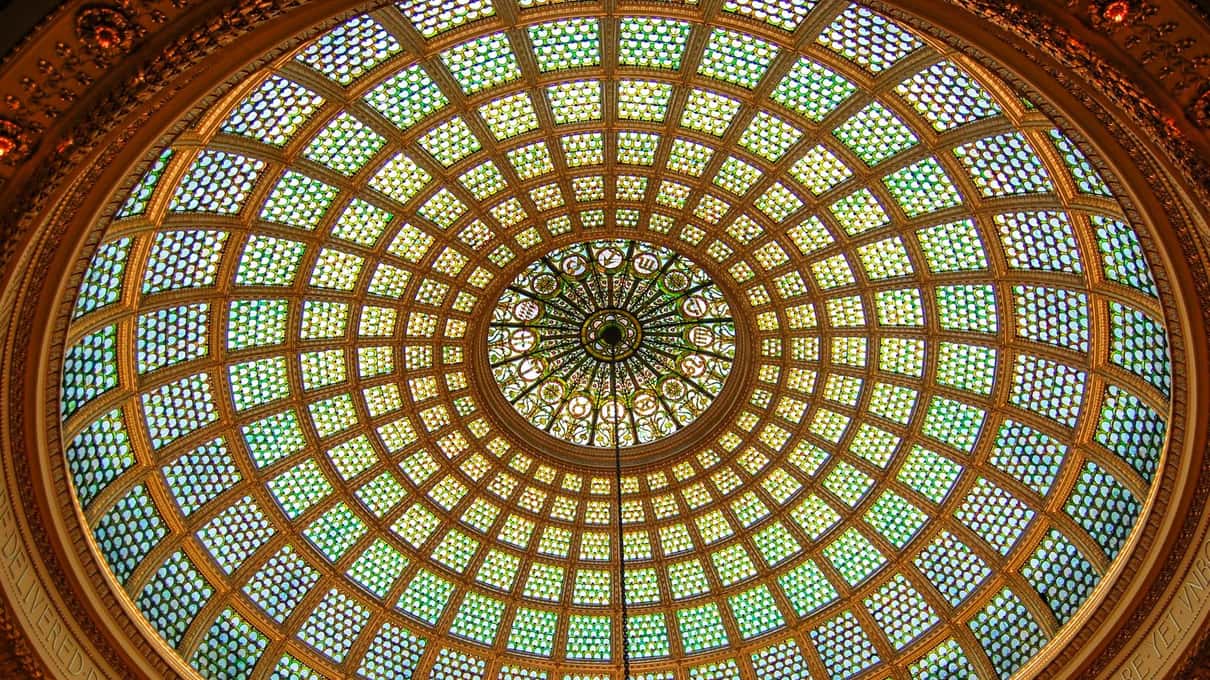
The Chicago Cultural Center opened in 1897 as the city's central public library, and it is free to enter when open. Upstairs, Preston Bradley Hall sits under a Tiffany dome that the tour listings call the world's largest Tiffany stained-glass dome. A second glass dome crowns the hall built for the Grand Army of the Republic on the other side of the building. Dazzling Interiors ends inside, and most of the main walks pass through.
A few blocks west, Macy's on State Street was Marshall Field's flagship, and a Tiffany mosaic dome still covers part of the store. The CAC's Historic Treasures walk includes it on GetYourGuide, and Empire's walk ends at the door. The Pedway tour passes through Macy's too. It is a working store, so you share the floor with shoppers.
Two hours, mostly indoors
Inside Chicago's walk usually starts in the Board of Trade's Art Deco lobby and ends under the Cultural Center's Tiffany dome, with surprise interiors in between, from ~$35. Entrance fees are included, and you can cancel free up to a day ahead.
Mosaics and painted ceilings
The Palmer House hotel keeps a lobby with painted ceilings, and both the CAC's Historic Treasures walk and Empire's Secret Interiors usually stop there. On Dearborn Street, the Marquette Building has a lobby lined with mosaics. None of the six main listings names it, so save it for a walk on your own.
Empire's walk starts in the Great Hall of Union Station, which makes the meeting point part of the tour. Inside Chicago keeps its own list partly secret. Its listing mentions a Postmodern vaulted ceiling with Moorish details without saying where, so part of the fun is the reveal.
Below the streets, through the Pedway
The Pedway links dozens of downtown buildings through several miles of tunnels and bridges. Inside Chicago's Pedway walk, from ~$35, uses it for stained-glass hallways and an underground swimming pool, with a pass through Block 37 on the way. Not every corridor is handsome. A handful of staircases rule out wheelchairs, and anyone uneasy in enclosed spaces should pick another walk. On a frozen day it is the sensible choice, as the best time for an architecture walk explains.
Which tour opens which door
| Interior | Usually on | Worth knowing |
|---|---|---|
| Rookery light court | Dazzling Interiors, Secret Interiors | Closed on Sundays |
| Board of Trade lobby | Dazzling Interiors | Art Deco, 1930 |
| Cultural Center domes | Most main walks | Free when open |
| Macy's Tiffany dome | Historic Treasures, Secret Interiors, Pedway | A working store |
| Palmer House lobby | Historic Treasures, Secret Interiors | A working hotel |
| Union Station Great Hall | Secret Interiors (the start) | A working station |
| Block 37 and the Pedway | Pedway and the Loop | Stairs, not for wheelchairs |
| Marquette lobby | None of the six | On our self-guided route |
Lobby manners
- These are working buildings. People are heading to meetings, so keep to the edges and out of the elevator lines;
- Say hello at the desk. Security staff decide who stays, and a polite word goes further than a guidebook;
- Leave the tripod at the hotel. Quick handheld photos are usually tolerated; tripods and long shoots are not;
- Keep voices low. A light court carries sound up every floor of offices;
- Let the guide lead. Guides know which side door is open this week, and that knowledge is much of what you pay for.
To visit the free rooms in a sensible order, follow our self-guided Loop architecture walk, and for the price of each guided option, see what a Chicago architecture walk costs. The story of how these buildings rose in the first place is in where the skyscraper was born.