Frank Lloyd Wright in the Loop and Oak Park
Frank Lloyd Wright's best-known Chicago work is out in the suburbs, but his story starts downtown in Louis Sullivan's office and in the Rookery's light court. This guide covers the Wright you can see on a Loop walk and the trip west to Oak Park, with a plan that fits both into one day.
Two places to find Wright
Frank Lloyd Wright spent roughly the first two decades of his career in and around Chicago, and the places to see his work split neatly in two. Downtown he left mostly traces, the most visible being his 1905 remodel of the Rookery's light court. Out west in Oak Park, a suburb about 9 miles (14 km) from the Loop, he built his own home and studio and a long run of houses for his neighbors. A third trip, south to Hyde Park, reaches Robie House. The Loop and Oak Park fit into one day; Robie House needs an outing of its own.
Sullivan's draftsman
Wright came to Chicago as a young man in the late 1880s and soon went to work for Adler & Sullivan, the firm of Louis Sullivan. He stayed for roughly five years and later called Sullivan his "Lieber Meister", his beloved master. You can see what the older man taught him at the Sullivan Center on State Street, where the cast-iron ornament over the corner entrance curls like plants grown into metal. The two fell out when Wright took on house commissions of his own on the side, and he went on to practice from Oak Park. For the wider story of the Chicago School that Sullivan belonged to, read where the skyscraper was born.
The Rookery light court in the Loop
The Rookery went up in 1888 to a design by Burnham & Root, with a glass-roofed light court at its heart. In 1905 Wright remodeled that court, covering much of the ornate ironwork in white marble incised with gilded geometric patterns and adding new light fixtures, so the room turned brighter and calmer. A later restoration brought much of his work back. Stand in the middle and you see both hands at once, Root in the iron staircase and the glass overhead, Wright in the pale marble.
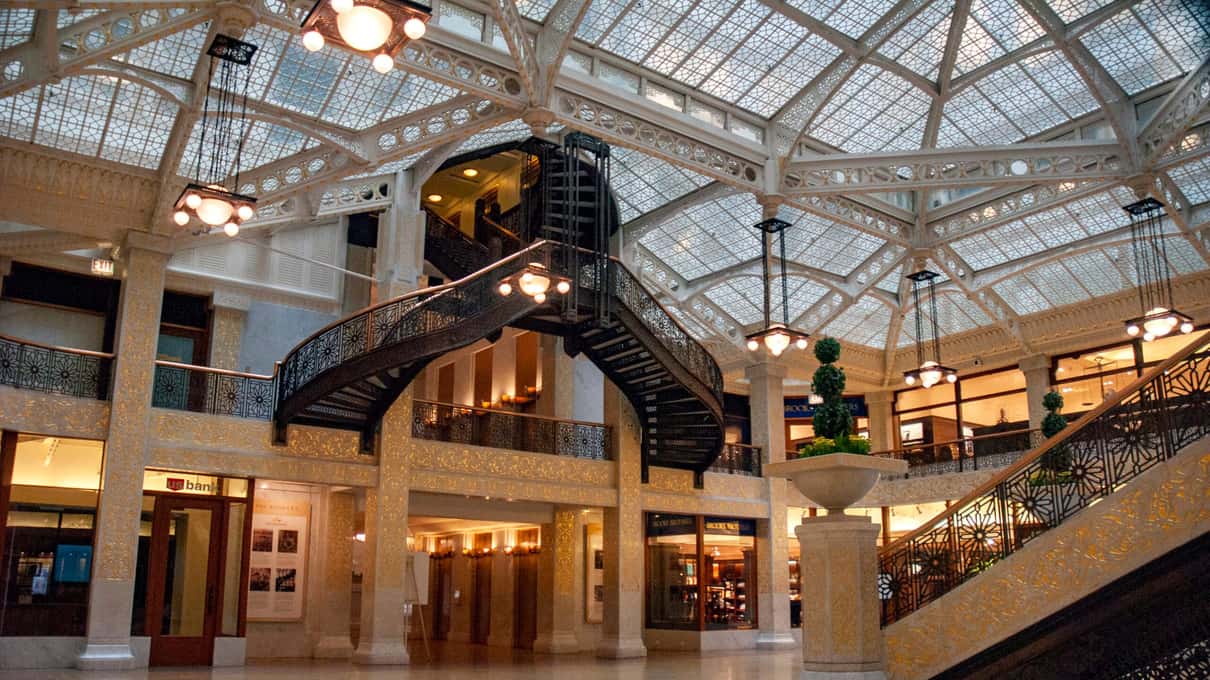
Two of the walks on our home page usually go inside. Inside Chicago's Dazzling Interiors walk, from ~$35, keeps its stops partly secret, but the listing promises an 1880s building renovated by Wright, and that is the Rookery. Empire Tours' Secret Interiors walk, from ~$30, names it outright. The Rookery is a working office building and closes on Sundays (Empire puts another stop in its place that day), and a private event or a security change can shut the lobby at other times, so no walk can guarantee it. Which other lobbies tend to open is covered in the Loop interiors you can walk into.
Union Station to the Rookery
Empire Tours meets under the Clinton Street sign in Union Station's Great Hall and usually reaches the Rookery light court by way of the LaSalle Street canyon, from ~$30, the lowest price of the six. On Sundays another stop replaces the Rookery, and groups can reach 30 people.
Oak Park and the Home and Studio
Wright built his house in Oak Park in 1889 and added the studio in 1898. There he and his draftsmen worked out what became the Prairie style, long low houses with broad overhanging roofs and rooms that flow into one another. The Home and Studio at 951 Chicago Avenue is now a museum, and the way in is a guided tour of about an hour.
On Viator, an advance ticket for the Home and Studio tour, from ~$27, scores 4.7 from 155 reviews. The catches come in a row. It is a train ride west of the Loop, entry is timed so you must turn up for your slot, groups top out at 16, and the house is not wheelchair accessible. It also sells on Viator only, so there is nothing to compare it against on GetYourGuide.
Unity Temple and the Prairie houses
A short walk from the Home and Studio, Unity Temple (1908) is a church of poured concrete, a bold material for a place of worship in its day, with a sanctuary lit from above. Whether you can step inside depends on its own schedule, so check before you set out. Wright's houses fill the streets around it, especially Forest Avenue, where one Prairie house follows another. Oak Park has more than two dozen Wright buildings, the largest group anywhere. Most are private homes, so admire them from the sidewalk and leave the owners in peace.
Unity Temple and Robie House belong to "The 20th-Century Architecture of Frank Lloyd Wright", the group of eight Wright buildings listed together as a UNESCO World Heritage Site in 2019.
Robie House on the South Side
Robie House (1910) stands in Hyde Park on the University of Chicago campus, and it is often called the finest of the Prairie houses, a long, low brick body under roofs that seem to float. It lies on the South Side, well away from both the Loop and Oak Park, so treat it as a separate half day rather than squeezing it in. None of the walks we compare goes there.
Getting there and a plan for the day
Oak Park is easy without a car. The CTA Green Line runs west from the Loop's elevated tracks (the "L") and gets you there in roughly 30 minutes. Metra trains head out that way too. A good day starts with a Loop walk in the morning, when office lobbies are most likely to be open, then the train west after lunch for a timed afternoon slot at the Home and Studio. The Dazzling Interiors walk ends inside the Cultural Center, close to elevated stations on the Green Line, which makes the handover easy. Our guide to the best time for an architecture walk explains the months, since the walk between Wright's houses is all outdoors.
Why no Oak Park walk on our home page? We looked. The CAC's Oak Park walk has few reviews (4.6 from 16 on Viator), and the private car tour on GetYourGuide scores 3.8, too thin a record to rank against walks with hundreds of reviews. The Home and Studio ticket plus your own stroll down Forest Avenue covers the same ground for less.
If you want a guide to yourselves downtown before heading west, Urban Adventures' private Hidden Chicago walk, from ~$178, gives you 2.5 hours starting at the Chicago Theatre. Its catch is the price, which is per person for a party of one and drops per head as your group grows, and the stories lean as much on Prohibition as on buildings. Our guide to private and small-group architecture walks compares it with booking a shared tour, and the self-guided Loop walk passes the Sullivan Center for free.